Egyptian temples are among the most fascinating monuments in the world. Their enormous gateways, towering columns, colorful reliefs, mysterious hieroglyphs and statues can seem overwhelming when you first visit. However, once you understand the basic design and symbolism of an ancient Egyptian temple, every wall and doorway begins to tell a story.
Egyptian temples were not simply places where people gathered to worship. They were sacred spaces designed according to religious beliefs, royal ideology and ancient ideas about the universe. Every architectural element had a purpose. The direction of movement through the temple, the position of the sanctuary, the images of gods and pharaohs, and even the way hieroglyphs were arranged were connected to the religious world of ancient Egypt.
For travelers visiting Egypt, learning how to read a temple can transform a sightseeing trip into a much deeper historical experience. Instead of seeing only enormous stone walls, you can recognize a pylon, understand the purpose of a hypostyle hall, identify important Egyptian gods and interpret scenes showing the pharaoh making offerings.
The temples of Karnak, Luxor Temple and Hatshepsut Temple are excellent places to practice these skills. Each monument is different, but together they reveal many of the most important principles of ancient Egyptian architecture and religion.
If you are staying in Hurghada and want to explore Egypt’s ancient heritage, organized excursions can also make these monuments easier to understand. Local tour providers such as Best Tours Hurghada can help travelers arrange trips to Luxor and other historical destinations while providing practical guidance during the journey.
Why Egyptian Temples Were Built
Before looking at individual architectural elements, it is important to understand what an Egyptian temple actually was.
Ancient Egyptian temples were primarily sacred institutions dedicated to gods, goddesses or, in some cases, deceased kings. They were places where priests performed rituals, offerings were presented to divine images, and religious ceremonies maintained the relationship between humans and the gods.
The Egyptians believed that maintaining divine order was essential to the survival of the world. This concept was closely connected with Ma’at, which represented truth, balance, justice, harmony and cosmic order.
The pharaoh had an important religious responsibility. He was considered the ideal intermediary between the human and divine worlds. Temple reliefs frequently show the king presenting offerings to gods, receiving symbols of authority from them or participating in rituals.
Although ordinary Egyptians could participate in festivals and approach certain outer areas of temple complexes, the deepest sacred spaces were generally restricted to priests and the king.
This explains an important feature of Egyptian temples: the farther you moved into the temple, the more sacred and restricted the spaces became.
Understanding the Basic Layout of an Egyptian Temple
Many Egyptian temples followed a general progression from large public spaces toward increasingly private sacred areas.
A simplified temple sequence might look like this:
Entrance → Pylon → Courtyard → Hypostyle Hall → Inner Rooms → Sanctuary
Not every temple follows this pattern exactly. Egyptian temples developed over many centuries, and individual monuments have unique layouts. Nevertheless, this sequence is extremely useful for tourists.
When walking through a temple, ask yourself:
- Where is the main entrance?
- What architectural element marks the entrance?
- Is the next area an open courtyard?
- Are there large numbers of columns?
- Does the architecture become darker and more enclosed?
- Where is the sanctuary?
- Which gods appear repeatedly?
- What is the pharaoh doing in the reliefs?
These questions can help you “read” the monument rather than simply photograph it.
1. The Pylon – The Monumental Gateway
One of the easiest features to recognize is the pylon.
A pylon is a massive monumental gateway formed by two large towers with a central entrance between them. The towers often have sloping sides and were decorated with reliefs, inscriptions and royal imagery.
When approaching an Egyptian temple, the pylon creates a dramatic transition between the outside world and the sacred complex.
The design was also symbolic. The towering gateway could be associated with the horizon and the rising sun. In ancient Egyptian religious thought, architectural spaces frequently had connections with cosmic ideas.
Look carefully at pylon decorations. You may see the pharaoh shown as a powerful ruler defeating enemies or making offerings to gods.
One particularly common image shows the king in a larger-than-life representation while striking enemies. This was not necessarily intended as a literal historical record of a particular battle. It also expressed the king’s role as protector of Egypt and defender of cosmic order.
What tourists should look for
When standing in front of a pylon, examine:
- The two monumental towers
- The central entrance
- Royal figures
- Gods and goddesses
- Hieroglyphic inscriptions
- Scenes of military victory
- Solar symbolism
- Flagstaff areas or representations
The pylon is therefore much more than an impressive entrance. It introduces the religious and political message of the temple.
2. Courtyards – Open Sacred Spaces
After passing through a pylon, visitors may enter a large courtyard.
Courtyards were generally more open and brighter than the inner areas of the temple. Some contained rows of columns, statues or processional routes.
A courtyard could serve as a transitional space between the monumental entrance and more restricted areas.
One of the most famous examples can be found at Luxor Temple, where large colonnades, statues and monumental architectural elements create a powerful sense of procession.
When visiting a courtyard, imagine the temple during an ancient religious festival. Priests, sacred objects, royal representatives and participants could move through ceremonial spaces as part of elaborate rituals.
This is one reason temple architecture should be understood as a sequence. Ancient Egyptians did not necessarily experience the temple in the same way as a modern tourist walking from one attraction to another.
The movement itself had religious meaning.
3. Hypostyle Halls – Forests of Stone Columns
The hypostyle hall is another iconic feature of Egyptian architecture.
The word refers to a hall in which the roof is supported by numerous columns. The result can resemble a massive stone forest.
The most famous example is the Great Hypostyle Hall at Karnak, which contains an extraordinary number of enormous columns.
The columns were not merely structural supports. Their decoration contributed to the religious atmosphere of the temple.
Many columns were decorated with:
- Hieroglyphic inscriptions
- Images of gods
- Pharaohs
- Offerings
- Religious symbols
- Plant-inspired capitals
Some column capitals resemble papyrus, lotus or other plants associated with the natural world of Egypt.
Why were columns so important?
Ancient Egyptian architecture often incorporated ideas from nature and creation. Plant forms could evoke the fertile landscape of the Nile and the emergence of life.
The columns also created a dramatic transition between light and shadow. As visitors moved from open courtyards into increasingly enclosed spaces, the architecture became more monumental and mysterious.
At Karnak, the scale of the Great Hypostyle Hall is particularly impressive. Rather than looking at every column separately, stand in the center and observe how the repeated forms create a sense of endless space.
4. Sanctuaries – The Most Sacred Areas
At the heart of many Egyptian temples was a sanctuary or group of inner sacred rooms.
This was one of the most restricted parts of the temple.
The sanctuary could contain a sacred image or shrine associated with the temple’s principal deity. Priests performed rituals involving offerings, purification, clothing and other ceremonial activities.
The temple was therefore not simply a building where people came to pray in the modern sense. It was part of an active ritual system.
The sacred image of a god was treated as a living divine presence within the ritual context. Daily ceremonies helped maintain the relationship between the deity, the king and the ordered universe.
As you move toward the inner sections of a temple, notice how:
- Rooms become smaller.
- Ceilings can become lower.
- Natural light decreases.
- Decorations become more concentrated.
- Access becomes more restricted.
This architectural progression reinforces the idea that you are approaching the most sacred part of the complex.
5. Egyptian Columns and Their Symbolism
Egyptian columns are among the most recognizable elements of ancient architecture.
They were not all identical. Different periods produced different forms, and many columns were decorated with plant-inspired capitals.
Common forms include columns associated with:
- Papyrus
- Lotus
- Palm trees
- Other stylized plant forms
The Nile was central to Egyptian life, agriculture and religious imagination. It is therefore unsurprising that plants associated with the Egyptian landscape became part of temple architecture.
When examining a column, look beyond its size.
Look at the capital at the top, the shaft in the middle and the inscriptions covering the surface. Some columns also preserve traces of ancient paint.
The colorful appearance of Egyptian temples has often been underestimated because modern visitors usually see the monuments in their weathered stone form. In antiquity, many temples were brightly painted.
6. How to Read Egyptian Hieroglyphs
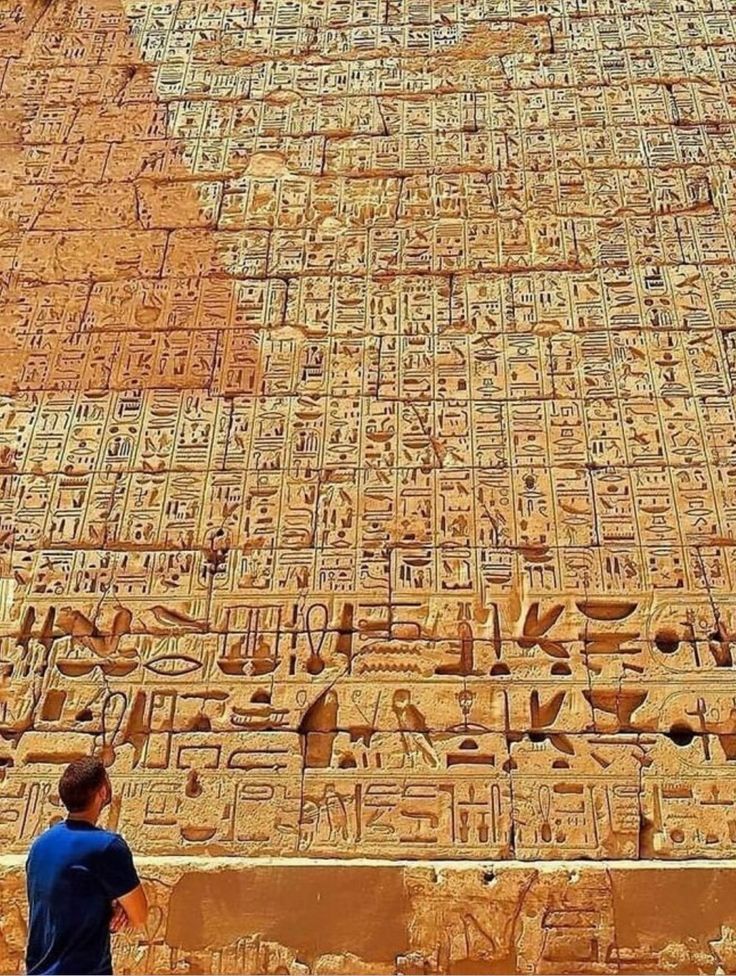
Hieroglyphs are one of the first things most tourists notice inside Egyptian temples.
The symbols may look like pictures, but hieroglyphic writing was a sophisticated writing system. Signs could represent sounds, words, concepts or grammatical information.
You do not need to become an Egyptologist to appreciate hieroglyphs.
Start by recognizing recurring symbols.
You may encounter images of:
- Birds
- Animals
- People
- Plants
- Tools
- Gods
- Crowns
- Ankhs
- Scepters
- Eyes
- Solar symbols
The direction in which figures face can help indicate the direction in which the text should be read. Hieroglyphic inscriptions can also be arranged vertically or horizontally.
Why are hieroglyphs everywhere?
Temple inscriptions recorded religious texts, royal names, offerings, rituals, titles and statements about the king and gods.
A pharaoh’s name may appear inside a cartouche, an oval-shaped enclosure surrounding the royal name.
Once you learn to recognize cartouches, temple walls become much easier to interpret.
You may discover that the same royal name appears repeatedly throughout a monument.
7. Understanding Reliefs
Egyptian temple walls are covered with reliefs showing gods, kings, ceremonies, offerings, battles and religious scenes.
These images followed conventions that can look unusual to modern visitors.
For example, Egyptian artists commonly represented the human body using a combination of different viewpoints. The head and legs may be shown from the side, while the torso appears more frontal.
This was not necessarily an attempt to create a realistic portrait. The goal was often to communicate important information clearly and symbolically.
Why is the pharaoh often larger?
Egyptian art frequently uses hierarchical scale.
Important figures can be represented larger than less important figures.
Therefore, when you see a giant pharaoh beside smaller people, do not automatically interpret the scene as a literal difference in physical size.
The image communicates status and importance.
8. How to Recognize Egyptian Gods
Egyptian temples can seem confusing because the same gods appear in different places, and many deities have several forms.
Some of the most important gods and goddesses you may encounter include:
Amun-Ra
Amun became one of the most powerful gods in ancient Egypt, particularly during the New Kingdom. At Karnak, Amun was the central deity of a major religious complex.
He was associated with kingship and divine power, and later became closely connected with the solar god Ra.
Ra
Ra was associated with the sun and was one of the most important deities in Egyptian religious tradition.
Solar imagery appears throughout Egyptian temples, including representations of the sun disk and solar journeys.
Osiris
Osiris was strongly associated with death, resurrection and the afterlife.
He is frequently represented as a wrapped, mummiform figure.
Isis
Isis was a major goddess associated with motherhood, magic, protection and kingship.
Her story is closely connected with Osiris and Horus.
Horus
Horus was associated with kingship and was often represented as a falcon or a human figure with a falcon’s head.
The pharaoh was closely connected with Horus during his earthly reign.
Anubis
Anubis is commonly represented with a jackal or jackal-headed form.
He was associated with funerary practices and the protection of the dead.
Hathor
Hathor was an important goddess associated with love, motherhood, music, joy and femininity. She can be represented as a woman with cow horns surrounding a solar disk or in other forms.
Mut
Mut was an important goddess associated with motherhood and became part of the Theban religious tradition alongside Amun and Khonsu.
Khonsu
Khonsu was associated with the moon and formed part of the Theban triad with Amun and Mut.
Recognizing these figures makes temple reliefs much easier to understand.
9. Why Gods Have Animal Features
Visitors often wonder why Egyptian gods appear with animal heads.
These representations were symbolic rather than simple depictions of animals being worshipped.
Different animals possessed characteristics that could be connected to particular divine powers.
For example:
- The falcon could symbolize the sky and royal power.
- The jackal was associated with funerary landscapes.
- The cow could symbolize motherhood and fertility.
- The ibis was associated with Thoth.
- The crocodile was associated with Sobek.
Egyptian religion did not operate according to one simple rule. Gods could have multiple forms and attributes, and their identities sometimes evolved over thousands of years.
10. Pharaohs and the Gods
One of the most common scenes inside an Egyptian temple shows the pharaoh interacting with a deity.
The king might be shown:
- Presenting food
- Offering flowers
- Burning incense
- Pouring liquid
- Presenting ritual objects
- Receiving symbols from a god
- Participating in a religious ceremony
These scenes emphasized the pharaoh’s role as the intermediary between humanity and the divine world.
Notice that the king is frequently shown wearing elaborate crowns.
Different crowns could communicate different aspects of royal authority.
The White Crown represented Upper Egypt, while the Red Crown represented Lower Egypt. The combined Double Crown symbolized the unity of the two lands.
Other royal headdresses and crowns carried additional religious or political associations.
11. Karnak Temple – A Masterclass in Egyptian Religion
Karnak Temple is one of the best places to learn how Egyptian temples developed over time.
Rather than being a single building constructed by one ruler, Karnak is an enormous religious complex that expanded over centuries.
The complex was especially associated with the Theban god Amun and became one of the most important religious centers in ancient Egypt.
At Karnak, tourists can observe:
- Monumental pylons
- Vast courtyards
- The Great Hypostyle Hall
- Obelisks
- Statues
- Hieroglyphic inscriptions
- Sacred lakes
- Processional routes
- Numerous temples and chapels
The Great Hypostyle Hall is particularly important.
Its enormous columns demonstrate the scale ancient Egyptian architects achieved, while the inscriptions and reliefs reveal the relationship between kingship and religion.
How to visit Karnak with more understanding
Instead of immediately taking photographs, spend a few minutes looking at the overall layout.
Ask:
Who built this section?
Which god was worshipped here?
What is the pharaoh doing in the relief?
Where does the procession lead?
What changes as I move deeper into the complex?
These questions turn the visit into an archaeological investigation.
12. Luxor Temple – A Temple Connected with Kingship
Luxor Temple offers another excellent lesson in Egyptian architecture.
Located on the east bank of the Nile, it was closely connected with the religious traditions of ancient Thebes.
The temple contains monumental statues, columns, courtyards and reliefs.
One of its most recognizable features is the grand entrance associated with Ramses II.
Look closely at the statues and reliefs. They demonstrate how royal imagery was incorporated into religious architecture.
Luxor Temple is also associated with the ancient Opet Festival, during which the sacred images of the Theban divine family were ceremonially transported between important religious centers.
This reminds visitors that Egyptian temples were connected through ritual landscapes. A temple was not necessarily an isolated building.
13. Hatshepsut Temple – Architecture on a Different Scale
The mortuary temple of Hatshepsut at Deir el-Bahari looks very different from the monumental temple complexes of Karnak and Luxor.
Its terraces rise dramatically against the cliffs of western Thebes.
Hatshepsut was one of ancient Egypt’s most famous female rulers. She adopted the traditional imagery of kingship and commissioned major construction projects.
Her temple demonstrates how architecture could be integrated with the natural landscape.
The terraces, colonnades and ramps create a strong visual relationship with the surrounding cliffs.
Inside the temple, visitors can study reliefs connected with religion, kingship and Hatshepsut’s famous expedition to the land of Punt.
What makes Hatshepsut’s temple special?
Unlike simply walking through a sequence of enclosed rooms, visitors experience a dramatic combination of:
- Mountain
- Terrace
- Colonnade
- Courtyard
- Sanctuary
- Relief decoration
- Processional space
The architecture itself communicates royal authority.
14. The Meaning of Obelisks
Obelisks are another important feature of Egyptian monuments.
An obelisk is a tall, four-sided stone monument with a pyramid-shaped top.
Obelisks were strongly associated with solar religion. Their shape and position connected them with the sun and divine power.
Several Egyptian temples contain obelisks, although many were later removed and transported to other parts of the world.
When looking at an obelisk, examine its inscriptions. The texts often identify the ruler who commissioned it and connect the monument with a particular deity or religious concept.
15. The Ankh and Other Important Symbols
Egyptian temples contain many recurring symbols.
The ankh, which resembles a cross with a loop at the top, is commonly interpreted as a symbol of life.
You may see gods presenting the ankh toward the pharaoh.
Another common symbol is the was scepter, associated with power or dominion.
The djed pillar is associated with stability and is particularly connected with Osiris.
The Eye of Horus became an important protective symbol.
The scarab was associated with regeneration and the solar cycle.
Understanding these symbols can make photographs and reliefs much more meaningful.
16. Color in Egyptian Temples
Ancient Egyptian temples were not originally the plain stone monuments that many tourists see today.
Many surfaces were painted.
Although much of the original color has disappeared, traces remain at various archaeological sites.
Color could have symbolic meaning.
For example, Egyptian artistic traditions often associated different colors with particular concepts, although meanings could vary depending on context.
When visiting a temple, look carefully at protected areas and recessed surfaces. You may notice surviving traces of pigment that reveal how colorful these buildings once were.
17. How to Understand the Direction of Temple Movement
One of the most useful concepts for tourists is procession.
Egyptian temples were designed around movement.
A visitor could pass from a monumental exterior into a courtyard, then into a columned hall and finally toward increasingly sacred rooms.
The architecture created a gradual transition.
Light could decrease.
Spaces could become narrower.
Access could become more restricted.
Religious imagery could become more concentrated.
This progression helped create a powerful sense of sacredness.
Therefore, when you visit a temple, do not only look at individual objects. Follow the route.
Imagine how priests, kings and sacred images might have moved through the complex during ceremonies.
18. Egyptian Temples Were Built Over Generations
Another important fact is that many famous temples were not completed during a single reign.
Karnak is the clearest example.
Pharaohs across different periods added pylons, chapels, columns, statues and inscriptions.
As a result, a single temple complex can contain evidence from different historical periods.
This also explains why you may see different pharaohs and gods represented in the same location.
Ancient rulers sometimes added to older monuments, reused earlier structures or changed religious programs.
This makes Egyptian temples valuable historical records.
19. How to Read a Temple Like an Archaeologist
You do not need specialist training to approach an Egyptian temple like an archaeologist.
Use a simple five-step method.
Step 1: Identify the architecture
Ask whether you are standing at a pylon, courtyard, hall, chapel or sanctuary.
Step 2: Identify the main deity
Look for repeated divine figures and symbols.
Step 3: Find the pharaoh
Look for royal names inside cartouches.
Step 4: Study the action
Ask what the king is doing.
Is he offering something? Receiving something? Performing a ritual? Defeating enemies?
Step 5: Look for the message
Ask what the scene is communicating.
Often the answer involves:
- Divine protection
- Royal authority
- Religious devotion
- Cosmic order
- Fertility
- Victory
- Eternal life
This simple method can dramatically improve your experience.
20. Tips for Visiting Egyptian Temples
Go early when possible
Early visits can provide softer light, cooler temperatures and fewer crowds.
Wear comfortable shoes
Temple complexes involve considerable walking.
Carry water
Egypt’s climate can be hot, especially during summer.
Bring sun protection
A hat, sunglasses and sunscreen can be useful.
Do not rush the inscriptions
You do not need to understand every hieroglyph. Focus on repeated symbols, names and scenes.
Take photographs from different distances
Start with a wide photograph showing the architecture. Then photograph individual columns, reliefs and details.
Listen to your guide
A knowledgeable guide can explain stories that are impossible to understand from the stonework alone.
Respect the monument
Do not touch fragile reliefs unnecessarily or climb onto restricted structures.
21. Best Times and Places to Learn About Ancient Egypt
If ancient Egyptian history is one of the main reasons for your trip, Luxor deserves special attention.
The city contains an extraordinary concentration of ancient monuments on both banks of the Nile.
A typical historical itinerary can include:
- Karnak Temple
- Luxor Temple
- Valley of the Kings
- Hatshepsut Temple
- Colossi of Memnon
Travelers staying in Hurghada can visit Luxor on an organized day trip, although a longer stay in Luxor is ideal for those who want more time for archaeology and history.
Companies such as Best Tours Hurghada can be useful for travelers looking for organized excursions from Hurghada to Luxor, particularly when transportation, sightseeing and itinerary planning are important considerations.
22. Frequently Asked Questions About Egyptian Temples
What was the main purpose of an Egyptian temple?
Egyptian temples were sacred institutions dedicated to gods, goddesses or deceased kings. Priests performed rituals, presented offerings and maintained the religious relationship between the divine world, the king and the ordered universe.
What is a pylon in an Egyptian temple?
A pylon is a monumental gateway consisting of two massive towers separated by a central entrance. It often carries royal and religious decorations.
What is a hypostyle hall?
A hypostyle hall is a large room whose roof is supported by numerous columns. The Great Hypostyle Hall at Karnak is one of the most famous examples.
What is inside the sanctuary?
The sanctuary was among the most sacred areas of a temple. It could contain a shrine or sacred image associated with the principal deity and was accessible only to a limited group of people.
Why are Egyptian gods shown with animal heads?
Animal forms were symbolic representations of divine characteristics. Different animals became associated with different gods and religious concepts.
How can I identify a pharaoh in temple reliefs?
Look for royal crowns, ceremonial clothing, royal poses and especially cartouches containing the king’s name.
Can tourists enter every part of an Egyptian temple?
No. Some areas may be restricted for conservation, archaeology, safety or religious and heritage-management reasons.
Which Egyptian temple is best for first-time visitors?
Karnak is an excellent introduction because of its enormous scale and variety of architectural features. Luxor Temple is also particularly accessible for understanding monumental entrances, columns, statues and royal reliefs. Hatshepsut Temple provides a different experience because of its dramatic terraces and relationship with the cliffs.
Conclusion: Learn to Read the Stones
Egyptian temples become much more fascinating when you understand what you are looking at.
A pylon is not simply a giant gateway. A hypostyle hall is not just a collection of enormous columns. A hieroglyph is not merely a decorative symbol. A relief showing a pharaoh and a god is part of a much larger religious and political message.
The architecture tells you how people moved through sacred space.
The hieroglyphs tell you who commissioned the monument and what religious ideas were important.
The reliefs show rituals, gods, kings and symbolic events.
The columns connect architecture with ideas about nature and creation.
The sanctuary represents the most sacred heart of the temple.
Karnak demonstrates the enormous scale and complexity of Egyptian religious architecture. Luxor Temple reveals the relationship between kingship, ritual and sacred processions. Hatshepsut Temple demonstrates how royal architecture could be integrated dramatically with the natural landscape.
Once you know these basic principles, visiting Egyptian temples becomes a completely different experience. Instead of seeing only ancient stones, you begin to recognize stories, symbols and religious ideas.
For travelers staying in Hurghada, a journey to Luxor is one of the best ways to experience this history firsthand. Whether you explore with a private guide, a small group or an organized excursion such as those offered by Best Tours Hurghada, take your time and look beyond the obvious monuments.
Stand beneath the columns.
Look at the cartouches.
Find the gods.
Follow the procession.
Study the reliefs.
Then imagine the temple as it once was: brightly painted, filled with priests and ceremonies, surrounded by sacred objects and connected to a civilization that lasted for thousands of years.
That is how to begin understanding the temples of ancient Egypt.